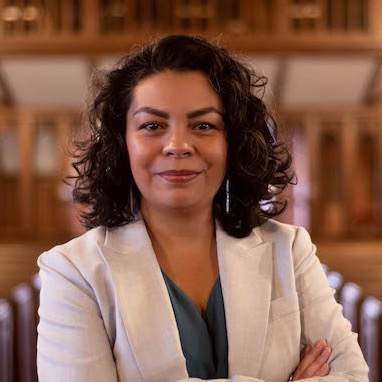
Following are opening remarks, lightly edited for clarity, by House of Deputies President Julia Ayala Harris to the Executive Council of The Episcopal Church, meeting Oct. 20-21 at Kanuga conference center in Hendersonville, North Carolina.
Acts 20:28 (NRSV): “Keep watch over yourselves and over all the flock, of which the Holy Spirit has made you overseers, to shepherd the church of God that he obtained with the blood of his own Son.”
Good morning, siblings in Christ.
It is good to be together in this holy place, gathered once again for the sacred work of church governance.
Kanuga has long been a setting where the church listens for God’s voice, where generations have prayed, planned, and renewed their commitment to serve Christ’s mission. Kanuga and its leaders are reminders that resilience and renewal are not abstract ideas; they are practices of faithfulness.
We will, at this meeting, elect someone to fill the vacancy left by Stan Baker, whose steady leadership, deaconal voice, and friendship continue to bless this body even as we grieve his loss and give thanks for his life among us.
Our colleague Timothy Gee joins us by Zoom today, having just returned home from successful heart surgery. We celebrate his recovery and hold him and his family in our prayers.
In the book of Acts, Paul gives this charge to the elders of the church at Ephesus: Keep watch. Keep watch over yourselves. Keep watch over the flock entrusted to you. Keep watch not only in prayer but also in practice, in the integrity of your stewardship, and in the courage of your decisions. Friends, this charge is also for us this week and throughout your term as elected members of Executive Council.
We meet in this holy place at a time when the world feels unsteady. Wars rage and displace millions. Famine and floods sweep across regions already stretched beyond endurance. Political violence in our own nation grows more personal, more bitter, and more dangerous. Trust in institutions—governmental, civic, and religious—has been shaken.
Even as Anglican bodies realign and tensions arise, for example through the recent declaration by GAFCON (Global Anglican Future Conference) claiming to constitute a separate “Global Anglican Communion,” our call remains the same. We are to stay anchored to the Gospel, not to chase each organizational shift in fear, but to lead with clarity, accountability, and faithfulness.
At home, public trust frays as conspiracy and cynicism rise, reminding us how fragile democracy becomes when truth and trust are neglected.
The temptation, in such a time, is either to mirror that instability or to withdraw from it. But as elected leaders serving our church, we are called to neither despair nor denial. We are called to steadiness, to model what it looks like to lead with courage, to govern with integrity, and to stay anchored in the Gospel when the ground beneath us moves.
This call to steadiness is no less urgent within the church itself. We are living through a demographic and cultural transition that touches every diocese, congregation, and pew.
According to last year’s published parochial report data, the median Average Sunday Attendance in The Episcopal Church is 38.
That means that on any given Sunday, half of our congregations worship with fewer people than are sitting in this very room. Executive Council, a single governing body, is now larger than the average parish we serve.
That reality should not discourage us: Even as attendance declines, faithfulness continues. In small congregations across the church, prayers are still offered, meals are still shared, baptisms are still celebrated, and the Gospel is still boldly proclaimed. The body of Christ is alive, even if it is smaller.
Future generations of leaders in the church will look back on this period and ask what we did when we knew that the way we’d always done it wasn’t doing it anymore. Did we act with courage, asking and answering hard questions? Did we steward well the abundance entrusted to us, investing in the transformational ministry of our congregations, or did we consume that abundance to hold tight to prestige and comfort? Did we speak boldly our message of God’s limitless love for the world, or did we whisper our welcome and dull our example?
All hope is not lost. This is not the time for a mindset of scarcity, but of abundance. Because at this moment, we still have the time, the people, and the imagination to strategize about what our future looks like. This is the moment for discipline, stewardship, and accountability.
If the call to keep watch is our charge, then Christian leadership defines how we do it. Christian leadership has never been about ease. It is about making hard decisions for the good of the whole body of Christ. It is about holding fast to mission when distractions threaten to pull our attention. Discipline, stewardship, and accountability are not optional values for Christian leaders; they are the very marks of our vocation as those who keep watch over the flock.
Discipline means resisting the temptation to privilege or prestige. It means focusing on mission, even when it’s costly or inconvenient.
Stewardship means holding every resource entrusted to us—money, time, energy, people—with care and purpose. It asks whether each decision brings us closer to proclaiming the Gospel or merely sustains our comfort.
Accountability means that our governance must reflect the Gospel itself: service, justice, reconciliation, and truth. Our systems and relationships are accountable when power is transparent, decisions are shared, and truth is spoken in love. It reminds us that our authority in the church is always derivative; it belongs first to God, and we hold it only in trust.
Guided by these values, and with our charge to keep watch, we take up our work this week.
On Tuesday, the General Convention Reinvention Steering Committee will provide an update on their work. This body is not responsible for directing General Convention, nor does it have authority over the structures of our governance. The Steering Committee’s purpose is to take a step back from the logistics and the Virtual Binders and the stanchions and to hold space for theological reflection. Through their leadership, they are helping the church ask the big questions of why.
Why do we gather at all? Why do we meet in the ways that we do? Why do we structure our common life as we have?
This group is hard at work, helping articulate a frame of our governance through a clear lens of serving the Gospel of Jesus Christ.
The Steering Committee’s work invites all of us into a conversation about common purpose; about opening the windows and letting the Spirit breathe through our structures.
We will also hear from our Chief Financial Officer Chris Lacovara, who will guide us through where we currently stand in our budget preparations and overall financial outlook. His report will ground our discernment in reality, reminding us that faithful imagination must be matched by sound stewardship.
And friends, keeping watch is not merely inward-facing. It extends to how we show up in the public square. This last tumultuous year globally and in the United States has only emphasized to me the reality that our governance can have public consequences.
Our church continues to lead on matters that test our moral resolve. For example, The Episcopal Church, along with others, joined litigation challenging the Department of Homeland Security’s unconstitutional decision to rescind the Sensitive Locations Policy, threatening our freedom of religion, which for decades protected our churches, schools, and hospitals from immigration enforcement actions. The presiding bishop and I submitted sworn statements in support of the case, which is currently pending in the Court of Appeals for the District of Columbia. As Episcopalians we know and believe that sacred spaces must remain sanctuaries of safety and welcome, part of our Gospel imperative as disciples.
This, too, is governance. This is what prophetic leadership looks like when it meets the world’s pain. It’s not partisan, it’s pastoral. It’s not performative, it’s protective. And it is exactly what discipline, stewardship, and accountability look like when they are lived out publicly for the sake of the Gospel.
Siblings, the storms will continue to come. The world will continue to shake. But the cross of Christ still stands. Our call is to shepherd the flock with steadiness, courage, and vision.
Acts 20:28 reminds us: Keep watch over yourselves and over all the flock.
That is our charge. To keep watch with discipline when it would be easier to drift.
To keep watch with stewardship when it would be easier to spend.
To keep watch with accountability when it would be easier to hide.
We find ourselves at that tipping point in the triennium where the energy of the church is turning from looking back at Louisville toward preparing for Phoenix. Diocesan conventions are gathering, and deputies are getting elected. As that shift takes place, our posture as the Executive Council of The Episcopal Church matters. The discipline, stewardship, and accountability we model here will shape the tone and expectations of the 82nd General Convention.
The horizon of Phoenix is coming into view. We have what we need—the people, the imagination, the resources—to shape a future rooted in faith rather than fear. Let us use them wisely. Let us invest in mission and ministry that will outlast us. Let us plant for the generations yet to come.
May we, as overseers of the flock of God, keep watch with courage, humility, and hope, so that when the next generation looks back on this moment, they will see not fear, but faithfulness.
The work before us is sacred. Let us begin.